
Researchers delivered mRNAs encoding DLL1, FLT3L and IL-7 to aged mice. The liver produced these signals, with improvements in T-cell and vaccine-response measurements.
A delivery experiment needs to establish where the instructions reach, whether cells translate them and which cells respond. An immune experiment then needs a challenge that tests what the changed population can do.
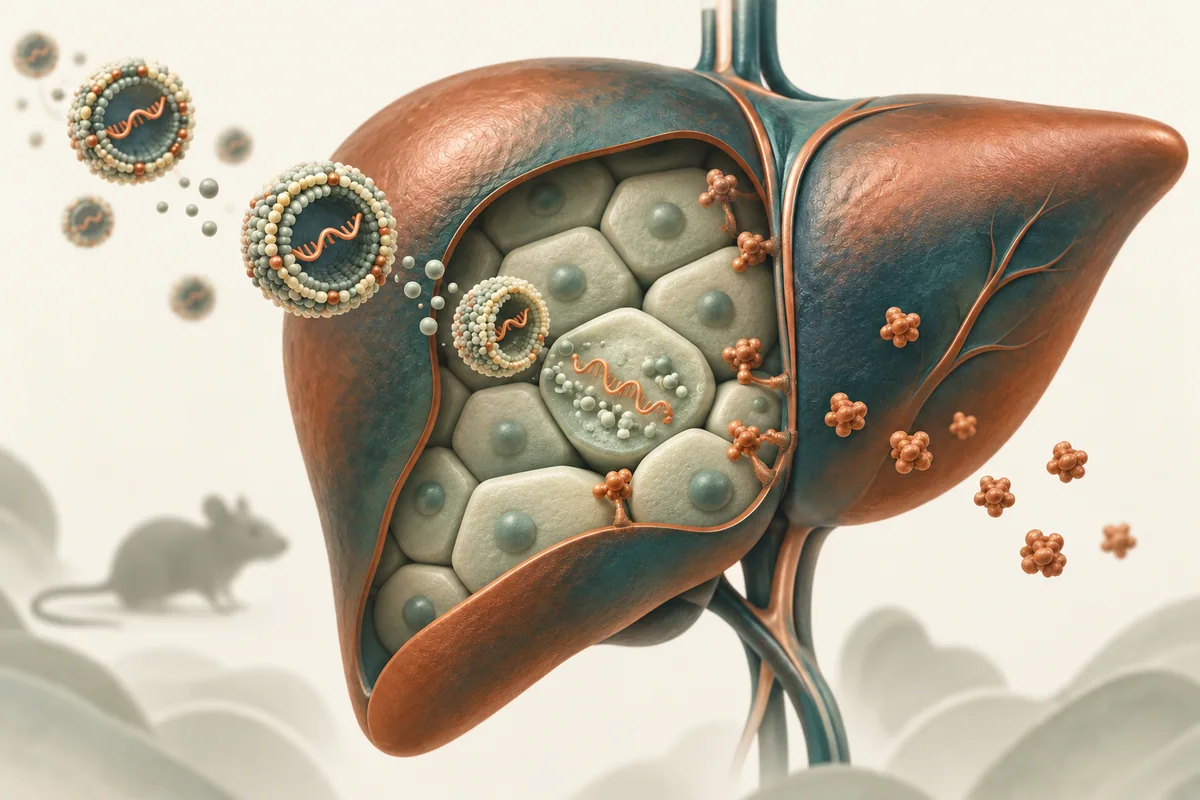
- Deliver the mRNA combinationInstructions encode DLL1, FLT3L and IL-7.
- Liver cells produce the signalsDLL1 acts at the surface; FLT3L and IL-7 can be secreted.
- Test immune responses in miceCell measurements and functional challenges assess the change.
The published effects are temporary and preclinical; the diagram shows no permanent reset. Sources for this account.
The mechanism
Lipid nanoparticles carry the mRNA instructions into cells. The study used liver cells to produce Delta-like ligand 1, Fms-like tyrosine kinase 3 ligand and interleukin-7, abbreviated DLL1, FLT3L and IL-7. DLL1 is a membrane signal requiring cell contact; the other two factors can be secreted. Delivery therefore changes where and how the signals are presented.
DLL1, Delta-like ligand 1, activates the Notch signalling pathway. Its connection with T-cell development predates this delivery study: Schmitt and Zúñiga-Pflücker showed that stromal cells expressing Delta-like-1 supported T-cell development from progenitors in culture. That experiment established a cell-development signal in a defined system.
FLT3L is a ligand for the FLT3 receptor. Waskow and colleagues established a role for FLT3 signalling in maintaining dendritic-cell numbers in mouse spleen. A change in these cells adds a separate measurement to the T-cell account.
IL-7, interleukin-7, participates in T-cell survival, with timing affecting the response. Kimura and colleagues found that prolonged IL-7 signalling caused naive CD8 T cells to proliferate and then die in their experimental system; intermittent signalling supported survival. The relevant engineering variables include duration and cellular context, alongside how much protein is produced.
Ageing also changes the cells that supply the immune system. Ross and colleagues tested antibody removal of blood stem cells biased toward myeloid output in aged mice, reporting improved immune responses. That is a separate intervention. The liver mRNA study did not reset stem-cell composition.
These approaches should be compared at the step each changes: the source of immune cells, their developmental environment or the behaviour of mature cells. One measurement can improve while another remains unchanged.
Human evidence
No human intervention results for the liver-delivered combination were verified in the cited sources. It remains preclinical research.
Human testing would need a defined formulation and evidence that it reaches the intended cells. It would then connect exposure to immune measurements and a stated clinical outcome. An increase in circulating cells, on its own, would leave questions about recognition of new targets, persistence and unwanted immune activity.
The duration deserves its own test. A short period of activity could support a research objective tied to a scheduled immune challenge. A claim about sustained restoration would require observation after treatment stops. Those are different study designs, and their endpoints should be chosen before results are interpreted.
For immune engineering, safety includes responses directed at the body's own tissue. A report should describe what researchers challenged, what they measured and how long they watched. A reassuring result in a particular animal model has a defined scope; it cannot settle every form of immune harm in people.
Studies and experimental evidence
Liver-directed DFI mRNA experiments
- Design
- Controlled mouse experiments
- Population or model
- Aged mice
- Sample size
- Figure 3 vaccine counts: four per group; other assays differ
- Comparison
- Control mRNA and individual factors
- Duration
- Twice weekly for 28 days; separate withdrawal observations
- Outcome
- Immune populations and function
Vaccine benefits were absent four weeks after dosing stopped.
Animal evidence; effects largely confined to dosing.
Funding and interests: Academic support; related patent interests disclosed
Development history
Study published online
The primary experimental report becomes available.
Journal issue published
Nature includes the earlier online paper in its February issue.
Supplementary table corrected
Duplicated Supplementary Table 3 replaced; the publisher records the correction.
Unresolved questions
- Which effects come from new T-cell production, and which from changes in existing cells?
- How do response timing and duration change across formulations and models?
- Does a functional immune challenge confirm the cell-count measurements?
- What happens when exposure is repeated or stopped?
- Which tests would detect inappropriate recognition of healthy tissue?
Further work should connect delivery, exposure and immune function through independently tested experiments. A human programme would require a separate protocol and results record; a molecular change would not establish a clinical benefit by itself.
Sources
- Paper · 17 Dec 2025Transient hepatic reconstitution of trophic factors enhances aged immunity
Nature. Corrected record; withdrawal analysis in Supplementary Figure 6.
Checked 4 Oct 2026 - Publisher record · 12 Feb 2026Nature, Volume 650, Issue 8101
Issue date; distinct from first online publication.
Checked 4 Oct 2026 - Paper · December 2002Induction of T cell development from hematopoietic progenitor cells by delta-like-1 in vitro
Immunity. Background cell-development experiment; no liver mRNA intervention.
Checked 4 Oct 2026 - Paper · 11 May 2008The receptor tyrosine kinase Flt3 is required for dendritic cell development in peripheral lymphoid tissues
Nature Immunology. Independent background experiment on dendritic-cell development.
Checked 4 Oct 2026 - Paper · 16 Dec 2012IL-7 signaling must be intermittent, not continuous, during CD8 T cell homeostasis to promote cell survival instead of cell death
Nature Immunology. Background on signal timing; publisher records a 2015 erratum.
Checked 4 Oct 2026 - Paper · 27 Mar 2024Depleting myeloid-biased haematopoietic stem cells rejuvenates aged immunity
Nature. Separate mouse intervention for comparison of immune-engineering mechanisms.
Checked 4 Oct 2026
Dr T Smith, organic chemist and science educator. Review date: 4 Oct 2026. Report a correction.