
Rentosertib is a small molecule designed to inhibit TNIK, a kinase involved in cell signalling. Insilico Medicine is developing it for idiopathic pulmonary fibrosis (IPF). The published discovery work describes AI-assisted target selection and chemistry before human testing.
The 2025 Phase 2a paper reports a randomised trial in 71 people over 12 weeks. Safety was its primary endpoint. The lung-function findings supported further investigation, although the size and duration could not answer the questions a longer efficacy trial must address.
On 10 September 2026, Insilico announced that the first participant had been dosed in GENESIS-IPF-3. The company describes a 52-week, placebo-controlled Phase 3 study with 320 planned participants. This is a development milestone, with results still to come.
- PandaOmics ranks targetsThe programme selected TNIK as a fibrosis hypothesis.
- Chemistry42 proposes moleculesResearchers evaluated molecular candidates.
- Experiments test the candidateLaboratory, animal and human results have distinct endpoints.
This workflow does not isolate what a different discovery method would have achieved. Sources for this account.
The mechanism
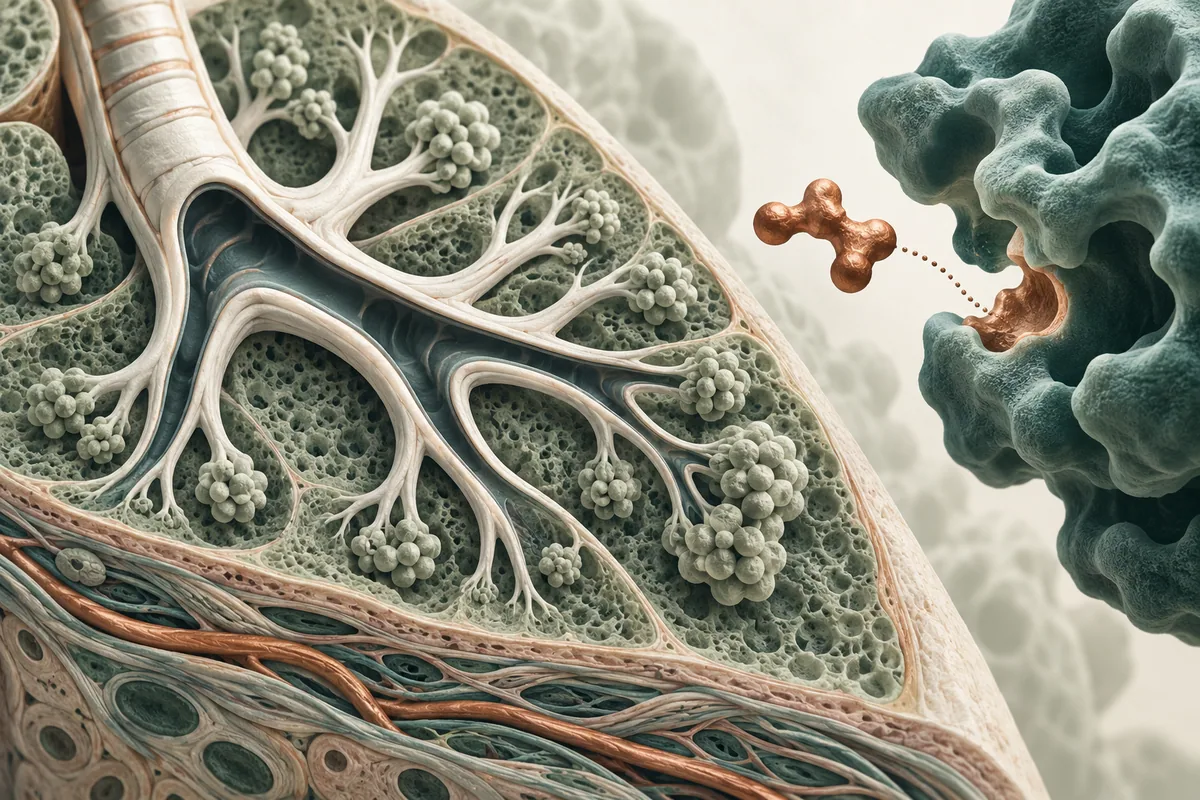
A kinase transfers phosphate groups to other molecules and can regulate downstream signalling. The discovery paper links TNIK to several processes involved in fibrosis, where excessive extracellular matrix damages tissue function. Laboratory and animal experiments tested whether inhibiting TNIK could reduce these fibrotic processes.
PandaOmics analysed biological data and prior evidence to rank target hypotheses. Chemistry42 then generated molecular candidates for researchers to evaluate. These are two distinct tasks. A target can be biologically relevant while a molecule aimed at it fails because of exposure, selectivity or tolerability.
The original discovery report follows the programme from those computational choices into experimental work and early clinical testing. It does not isolate how this programme would have progressed with a different discovery method.
Human evidence
In Phase 2a, treatment-emergent adverse events occurred across active and placebo arms; liver toxicity and diarrhoea were among the events associated with stopping treatment. The highest active arm had a mean forced-vital-capacity change of +98.4 mL, compared with −20.3 mL on placebo. These are small-group, 12-week observations, not established long-term disease reversal.
The 7 September 2026 paper applied six proteomic clocks to samples from 42 participants in the existing trial. The clocks predicted lower biological age in treated groups. Its authors state that the clocks cannot fully separate changes caused by treating fibrosis from changes in ageing itself. The analysis did not measure lifespan or test rejuvenation in healthy people.
Studies and experimental evidence
AI-assisted TNIK discovery and early validation
- Design
- Computational discovery, preclinical models and Phase 1
- Population or model
- Cell and animal fibrosis models; healthy volunteers
- Sample size
- 78 in the reported Phase 1 trial
- Comparison
- Experiment-specific controls and placebo
- Duration
- Varied
- Outcome
- Antifibrotic activity, exposure and tolerability
Candidate progressed from computational design into experimental validation
Development evidence does not quantify AI's counterfactual advantage
Funding and interests: Developer-linked research; see full disclosures
Rentosertib Phase 2a
- Design
- Multicentre randomised double-blind placebo-controlled trial
- Population or model
- People with IPF
- Sample size
- 71
- Comparison
- Placebo
- Duration
- 12 weeks
- Outcome
- Primary: treatment-emergent adverse events; secondary: lung function and other measures
Similar overall adverse-event proportions; a lung-function signal in the highest active arm
Small groups and short follow-up
Funding and interests: Insilico-linked programme and authorship; see paper disclosures
Proteomic clocks in Phase 2a samples
- Design
- Ancillary analysis of stored longitudinal samples
- Population or model
- Subset of Phase 2a participants with IPF
- Sample size
- 42
- Comparison
- Treatment groups and placebo
- Duration
- 12 weeks
- Outcome
- Six proteomic ageing-clock predictions
Lower predicted age in treated groups
Same clinical dataset; disease and ageing effects cannot be fully separated
Funding and interests: Developer-affiliated authors; commercial interests disclosed
GENESIS-IPF-3
- Design
- Randomised double-blind placebo-controlled Phase 3, according to developer
- Population or model
- People with IPF
- Sample size
- 320 planned
- Comparison
- Placebo
- Duration
- 52 weeks
- Outcome
- Annual rate of forced-vital-capacity decline
First dosing announced; efficacy findings not released
Planned sample and future results
Funding and interests: Insilico Medicine programme
Development history
Discovery and early testing published
Nature Biotechnology documents AI-assisted target selection and molecular generation alongside experimental validation.
Phase 2a results published
Nature Medicine reports the 71-participant randomised IPF study.
Ageing-clock analysis published
Ancillary analysis asks what proteomic changes in the existing trial indicate about ageing biology.
Phase 3 first dosing announced
Insilico reports the start of dosing in GENESIS-IPF-3, identified as NCT07687459.
Unresolved questions
- Will the Phase 3 lung-function result reproduce the earlier signal over 52 weeks?
- How will adverse events and discontinuations compare in the larger study?
- Do the proteomic changes predict patient outcomes beyond their association with fibrosis?
- Which parts of the ageing-clock result can be replicated in an independent dataset?
GENESIS-IPF-3 is the next major clinical test. Its registered endpoints and subsequent results will address lung disease. A broader ageing hypothesis needs experiments that can distinguish disease improvement from effects on ageing in other tissues.
Sources
- Paper · 8 Mar 2024A small-molecule TNIK inhibitor targets fibrosis in preclinical and clinical models
Original discovery, AI contribution, mechanism and early experimental validation.
Checked 4 Oct 2026 - Paper · 3 Jun 2025A generative AI-discovered TNIK inhibitor for idiopathic pulmonary fibrosis: a randomized phase 2a trial
Clinical results, DOI 10.1038/s41591-025-03743-2; primary endpoint is safety.
Checked 4 Oct 2026 - Paper · 7 Sept 2026Integration of proteomic aging clocks in a phase 2a clinical trial supports simultaneous geroprotective assessment
42-participant ancillary analysis; authors explicitly discuss disease/ageing confounding.
Checked 4 Oct 2026 - Company disclosure · 10 Sept 2026Insilico doses first patient in GENESIS-IPF-3
Primary source for first-dosing announcement and proposed Phase 3 design; commercial developer disclosure.
Checked 4 Oct 2026
Dr T Smith, organic chemist and science educator. Review date: 4 Oct 2026. Report a correction.