
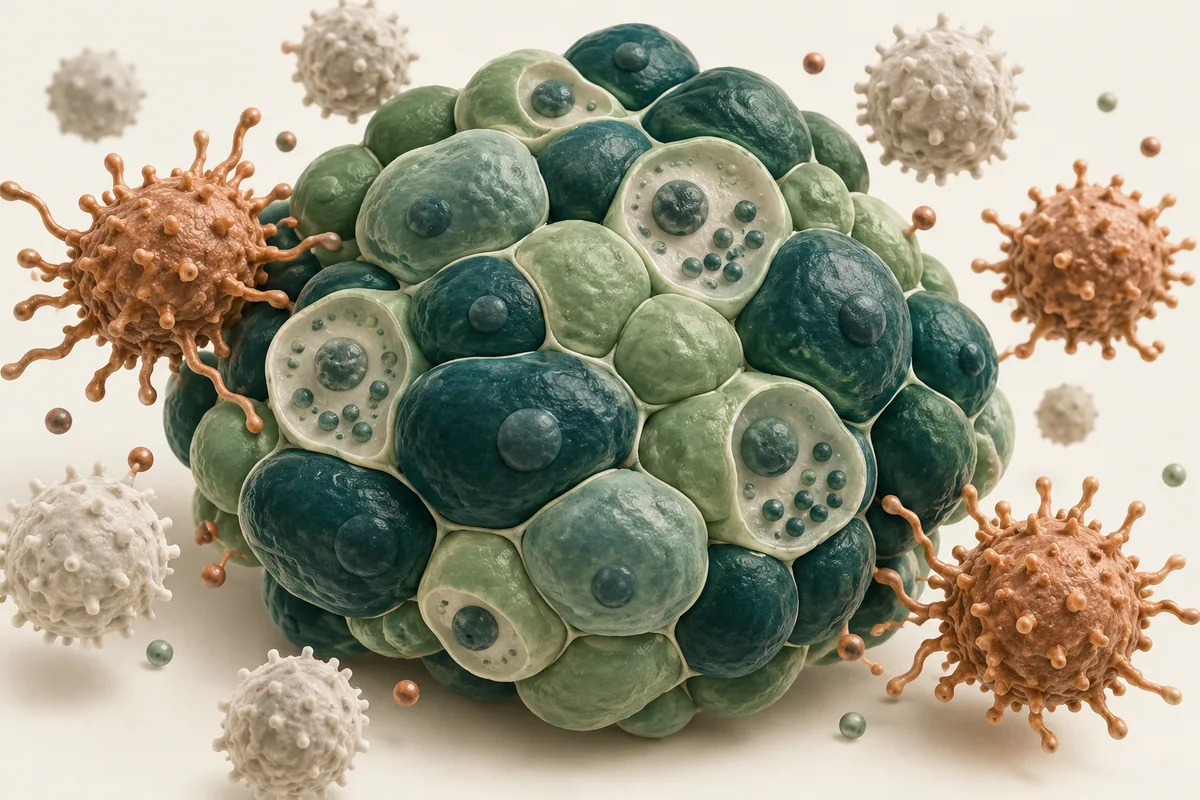
Cell replacement has a supply problem and an immune problem. Researchers need enough working cells, and those cells have to remain useful after transplantation. Two islet studies let us examine these problems separately. Their results concern type 1 diabetes; neither study tests a treatment for ageing.
Islets are clusters of pancreatic cells. Their beta cells make insulin, which helps regulate blood glucose. In type 1 diabetes, the immune system destroys beta cells. Transplanting islets can restore insulin production, but donor tissue is limited and conventional transplantation requires medicines that suppress rejection. Those medicines bring risks of their own, including infection and kidney damage.
A replacement strategy therefore needs to specify both the origin of its cells and how it deals with the immune system. The phrase ‘new insulin-producing cells’ leaves half the engineering problem unspecified.
Two experiments with different endpoints
The June 2025 zimislecel paper reported interim results for 14 participants followed for at least a year. Twelve received the full dose; ten of those twelve were using no external insulin at day 365. Participants received immunosuppression. The analyses were not prespecified. Serious neutropenia occurred in three participants, and the paper reported two deaths, from cryptococcal meningitis and progression of pre-existing neurocognitive impairment.
UP421 tested gene-edited islets from a donor in one man, transplanted into forearm muscle without immunosuppressants. The August 2025 paper described twelve weeks of observation: the cells produced glucose-responsive insulin, and testing found no immune response against them. Four adverse events were recorded, none serious or attributed to the study treatment.
An insulin-secretion measurement answers whether a graft is doing something useful. Insulin independence answers whether its output can meet the person's needs under the conditions studied. A positive result for the first endpoint cannot be substituted for the second. Comparing the trials as if they were competing scores would conceal the question each team set out to answer.
Scroll the table sideways to read all columns.
| Study | Cell source and immune approach | Evidence in the cited paper |
|---|---|---|
| Zimislecel, June 2025 | Stem cell-derived islets; immunosuppression | 14 participants; 10 of 12 full-dose recipients insulin-independent at day 365 |
| UP421, August 2025 | Edited donor islets; no immunosuppression | One participant; functioning graft through 12 weeks, without a detected immune response |
Follow the same graft, then test the next product
Sana's July 2026 disclosure identified a peer-reviewed NEJM letter reporting fourteen-month follow-up of the UP421 participant. It described continuing C-peptide production, including a response to a mixed meal. C-peptide provides evidence that the transplanted cells are making insulin. The company also stated that the low-dose study was not designed to show improved glucose control or reduced use of external insulin. The disclosure is linked below; the journal letter's full text was not accessible during this review.
Follow-up in the same person improves the duration of the observation. It does not enlarge the population. Fourteen months in one participant still leaves uncertainty about variation among recipients and uncommon harms.
SC451 is a separate Sana product: stem cell-derived islets carrying the company's immune-evasion modifications. In its 10 August 2026 update, Sana described toxicology, manufacturing transfer and trial preparation, with an IND submission and a Phase 1/2 start expected as early as 2026. That was a development plan. UP421's clinical findings belong to UP421.
Vertex's 3 August 2026 update said enrolment and dosing continued in the zimislecel Phase 1/2/3 study. They add no new comparative efficacy result to the table.
Following the graft
Start with cell identity, quantity and function, then ask how the graft was protected and where it was placed. Record the outcome and its duration. A cell can survive while producing too little of what the body needs; it can function initially and fail later.
For an immune-evasive graft, useful further evidence would include repeatable function across recipients and long observation of the edited cells. For a graft requiring immunosuppression, the treatment's benefit and the burden of immune suppression belong in the same account. A study needs to measure them; the appeal of cell replacement cannot settle that balance.
Extending these findings to replacement of another tissue would require experiments testing that tissue's function.
Sources
- Institutional explanation · Not stated on the checked pagePancreatic Islet Transplantation
Background on islets, donor supply and immunosuppression; not evidence for the experimental products.
Checked 4 Oct 2026 - Paper · 20 Jun 2025Stem Cell–Derived, Fully Differentiated Islets for Type 1 Diabetes
Vertex-funded interim study. Published abstract reports the participant counts, one-year endpoints and serious adverse events. Online publication date; September issue date.
Checked 4 Oct 2026 - Paper · 4 Aug 2025Survival of Transplanted Allogeneic Beta Cells with No Immunosuppression
Primary NEJM study abstract, DOI 10.1056/NEJMoa2503822. One participant and twelve-week follow-up. Supported by the Helmsley Charitable Trust.
Checked 4 Oct 2026 - Company disclosure · 13 Jul 2026Sana announces NEJM follow-up publication reporting fourteen-month UP421 results
Company account of NEJM letter 10.1056/NEJMc2604408; full journal letter was unavailable during this review. Explicitly describes the low-dose study's limited objectives.
Checked 4 Oct 2026 - Company disclosure · 10 Aug 2026Sana Biotechnology Reports Second Quarter 2026 Financial Results and Business Updates
Dated SC451 development and trial-preparation plans; not a clinical result for SC451.
Checked 4 Oct 2026 - Company disclosure · 3 Aug 2026Vertex Reports Second Quarter 2026 Financial Results
Dated zimislecel enrolment and dosing update; not a new efficacy analysis.
Checked 4 Oct 2026
Dr T Smith, organic chemist and science educator. Report a correction.