
ER-100 is an experimental gene therapy for damaged retinal ganglion cells, the neurons that carry visual information from the eye toward the brain. Its first human study concerns open-angle glaucoma and non-arteritic anterior ischaemic optic neuropathy (NAION). The immediate research question is whether controlled expression of reprogramming factors can be tolerated in these cells and improve their function.
Life Biosciences announced the first participant had received ER-100 on 9 June 2026. The company then announced on 1 October that it would present interim glaucoma-cohort data at Eyecelerator on 8 October. No numerical human findings from that presentation were available in the material verified for this dossier.
Changes in visual performance would need to be interpreted with the study design, the participant's underlying condition and the length of follow-up. This initial study is small and open label; it compares observations with each participant's baseline.
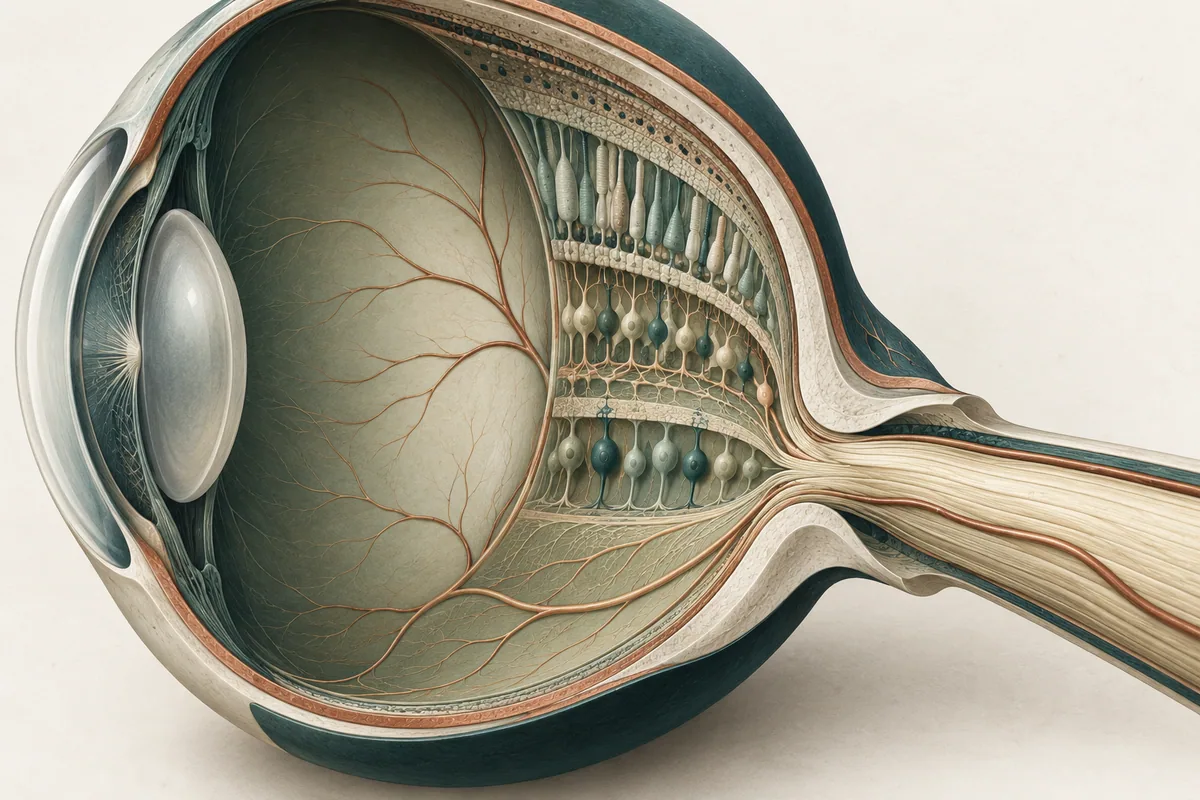
- AAV carries OSK instructionsOCT4, SOX2 and KLF4 are regulatory factors.
- Expression in retinal cellsThe experimental system controls expression with doxycycline.
- Observe safety and visionThe human study has its own design and endpoints.
This is the proposed mechanism and assessment chain; it shows no human efficacy result. Sources for this account.
The mechanism
OCT4, SOX2 and KLF4, collectively OSK, are transcription factors: proteins that help regulate which genes a cell expresses. ER-100 delivers instructions for OSK using a modified adeno-associated virus. The experimental system controls expression with doxycycline. It aims to change gene regulation in existing retinal cells.
The scientific foundation includes a 2020 mouse study in which OSK expression changed DNA methylation and gene expression, promoted axon regeneration after injury and improved visual function in glaucoma and ageing experiments. Those results connect reprogramming to tissue performance in an animal model. They do not establish how a human optic nerve will respond.
Life Biosciences subsequently reported nonhuman-primate experiments with an injury resembling NAION. Its 2024 conference disclosure described improvements in electrical-response and axon-density measurements. Conference and company reports require their own evidence label; the experimental particulars should be checked against a full report when available.
Human evidence
NCT07290244 plans to enrol up to 18 adults, with sequential glaucoma and NAION cohorts. The registry describes safety and tolerability as the principal purpose, with visual assessments and long-term monitoring. The record checked for this dossier listed no posted results. The estimate of primary completion is May 2027, followed by longer safety follow-up.
A trial beginning in a specific optic neuropathy does not establish treatment of ageing throughout the body. The local delivery, target cells and outcome measures define what this experiment can answer. An encouraging early observation would support further testing of this programme; a convincing claim about restoring vision will need the full data and an appropriate subsequent comparison.
Studies and experimental evidence
ER-100 Phase 1, NCT07290244
- Design
- Open-label, non-randomised sequential cohorts
- Population or model
- Adults with open-angle glaucoma or NAION
- Sample size
- 18 planned; actual treated total not verified
- Comparison
- Participant baseline; no randomised control
- Duration
- Initial assessments with follow-up planned to five years
- Outcome
- Safety, tolerability and exploratory visual measures
No posted registry results in the checked record
Small initial study; open label; planned numbers are not completed enrolment
Funding and interests: Sponsor: Life Biosciences
Reprogramming to recover youthful epigenetic information and restore vision
- Design
- Laboratory and mouse experiments
- Population or model
- Mouse retinal ganglion cells and optic-nerve disease/injury models
- Sample size
- Varies by experiment; not a single trial sample
- Comparison
- Experimental controls described in the paper
- Duration
- Varies by assay
- Outcome
- Methylation, gene expression, axon regeneration and visual function
OSK expression improved several molecular and functional measures in mice
Preclinical foundation; not a human ER-100 efficacy result
Funding and interests: Academic work; see paper for grant and commercial-interest disclosures
Nonhuman-primate ER-100 conference disclosure
- Design
- Preclinical injury-model experiments, company conference report
- Population or model
- Nonhuman primates with NAION-like injury
- Sample size
- Not reported in the checked disclosure
- Comparison
- Vehicle controls
- Duration
- Not fully reported in the checked disclosure
- Outcome
- Pattern electroretinogram and axon density
Company reported reduced functional and structural deficits
Source is a company summary of conference data; complete methods needed
Funding and interests: Life Biosciences programme
Development history
Mouse vision study published
OSK research connected molecular reprogramming with retinal function in experimental mice.
Primate data disclosed
Life Biosciences reported further NAION-like injury-model results at AAO.
IND clearance announced
The company announced FDA clearance to begin ER-100 human testing. Clearance to test is distinct from approval to market a treatment.
First participant dosed
Life Biosciences announced the first administration in its Phase 1 trial.
Interim presentation scheduled
Company announcement schedules a glaucoma-cohort presentation for 8 October, after this dossier's verification date.
Unresolved questions
- How many participants and how much follow-up will the interim disclosure cover?
- Do several visual assessments agree, and how do they relate to baseline variability?
- Does the effect persist after OSK expression is switched off?
- What ocular, immune or other adverse events appear with longer observation?
- Which findings would justify a subsequent controlled efficacy study?
Life Biosciences has scheduled its interim presentation for 8 October 2026. Participant numbers, follow-up, adverse events and visual outcomes will determine what those findings establish. The registry's estimated completion dates remain planning information.
Sources
- Trial registry · 19 May 2026ER-100 Phase 1: NCT07290244
Sponsor-submitted record; planned design and completion dates, no posted results in checked record.
Checked 4 Oct 2026 - Paper · 2 Dec 2020Reprogramming to recover youthful epigenetic information and restore vision
Nature; DOI 10.1038/s41586-020-2975-4. Preclinical scientific foundation.
Checked 4 Oct 2026 - Company disclosure · 21 Oct 2024Life Biosciences presents nonhuman-primate reprogramming data at AAO
Conference findings summarised by the developer.
Checked 4 Oct 2026 - Company disclosure · 28 Jan 2026Life Biosciences announces IND clearance for ER-100
Primary source for company announcement; does not establish marketed approval.
Checked 4 Oct 2026 - Company disclosure · 9 Jun 2026First patient dosed in ER-100 Phase 1
Actual dosing announcement, separate from registry start date.
Checked 4 Oct 2026 - Company disclosure · 1 Oct 2026ER-100 interim data presentation announced for Eyecelerator 2026
Presentation scheduled for 8 October 2026; announcement contains no numerical clinical results.
Checked 4 Oct 2026
Dr T Smith, organic chemist and science educator. Review date: 4 Oct 2026. Report a correction.