
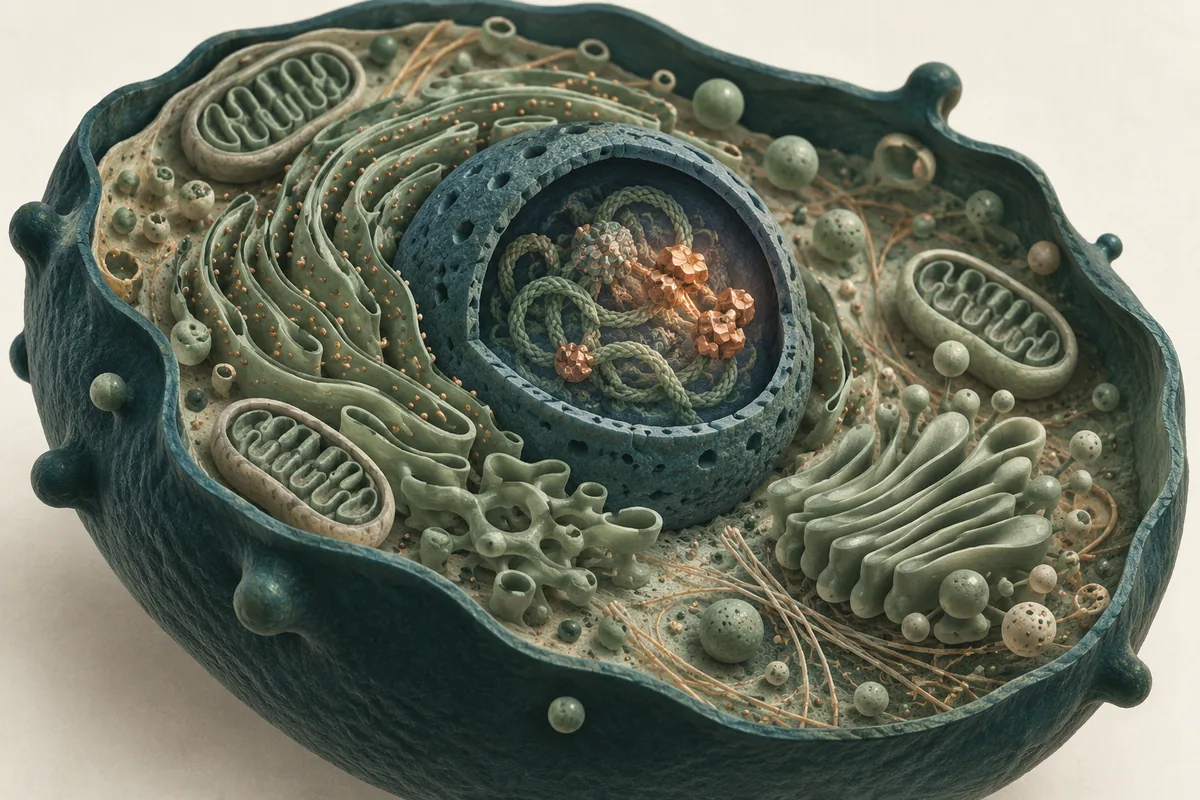
A skin cell and a nerve cell use much of the same DNA. Their different functions depend on which genes they express and how that expression is controlled. Reprogramming changes those controls.
Full reprogramming can turn a specialised cell into an induced pluripotent stem cell. Researchers studying rejuvenation interrupt or restrict that process. They want selected properties of the cell to improve while the cell retains the identity and behaviour needed by its tissue.
The usual factors are transcription factors: proteins that influence gene expression. OSKM refers to OCT4, SOX2, KLF4 and c-MYC. Some programmes use OSK and omit c-MYC. Changing the factor set changes the experiment; it does not supply a universal safety guarantee.
- Change gene regulationUse a defined set of factors and exposure period.
- Check cell identityThe specialised cell must retain its useful role.
- Measure its functionConnect molecular changes to the task the cell performs.
The diagram describes the questions in the experiment, not a demonstrated treatment outcome. Sources for this account.
Several experiments, several kinds of evidence
Ocampo and colleagues reported in 2016 that cyclic expression of reprogramming factors improved selected ageing-associated features in mice. Their lifespan result concerned a premature-ageing model. Experiments in older, normally ageing mice examined resistance to particular injuries and metabolic stress.
The 2020 retinal study by Lu and colleagues used OSK in mouse retinal ganglion cells. It examined nerve regeneration, gene expression, methylation patterns and visual function under defined injury or ageing conditions. The functional measurements make the work more informative than a clock measurement alone.
Gill and colleagues investigated transient reprogramming in cultured human fibroblasts in 2022. They assessed molecular profiles and cellular characteristics after the cells recovered. Human cells in a dish offer a direct look at human cell biology; they do not reproduce the delivery, immunity or tissue interactions of administration to a person.
None of these experiments defines a single amount of reprogramming that is suitable for every tissue. Cells differ in how they respond, and a tissue contains several interacting cell populations.
Controlling the process
A programme needs to control which cells express the factors, how strongly they express them and how long expression continues. It must also establish what happens after expression stops. A change that fades quickly creates a different development problem from a persistent change.
Stopping expression is not enough to establish safety. Ohnishi and colleagues showed that prematurely terminated reprogramming could produce cancer in a mouse experimental system. That result should be read in its specific context, but it rules out treating interruption itself as proof that a protocol is harmless.
The evaluation needs several measurements. Cell identity markers can show whether the intended cell type persists. Functional tests can show whether those cells perform their job. Tissue examination can detect abnormal growth or organisation. Longer observation can reveal changes that were absent immediately after treatment.
A decrease in methylation age adds information about the molecular state. It cannot answer all of those questions.
A retina is a useful place to begin a focused programme because researchers can study a defined tissue and measure aspects of vision. A result in that tissue would support the tested intervention and population. Extending the claim to other organs would require further delivery and biological evidence.
One unresolved question is how far a cell can recover while damage elsewhere remains. Reprogramming alters gene regulation; an aged tissue can also contain damaged extracellular structures, lost cells and disrupted connections. Experiments need to measure which of those problems improve and which remain.
Assess the complete protocol: factors, delivery system, target cells, expression control and follow-up. Projects using the same OSK factors can still differ in each of these respects.
Sources
- Paper · 15 Dec 2016In Vivo Amelioration of Age-Associated Hallmarks by Partial Reprogramming
Mouse experiments; distinguishes a premature-ageing model from physiological ageing.
Checked 4 Oct 2026 - Paper · 2 Dec 2020Reprogramming to recover youthful epigenetic information and restore vision
Mouse retinal research and laboratory experiments; not ER-100 clinical results.
Checked 4 Oct 2026 - Paper · 8 Apr 2022Multi-omic rejuvenation of human cells by maturation phase transient reprogramming
Human fibroblasts in culture; this was not administration to human volunteers.
Checked 4 Oct 2026 - Paper · 13 Feb 2014Premature termination of reprogramming in vivo leads to cancer development through altered epigenetic regulation
Mouse study showing that stopping reprogramming does not itself guarantee safety.
Checked 4 Oct 2026
Dr T Smith, organic chemist and science educator. Report a correction.