
A senolytic CAR T cell is an immune cell engineered to kill a chosen cellular target. The receptor supplies the recognition rule: it binds a protein on another cell and activates the T cell's killing machinery. This research uses uPAR, the urokinase-type plasminogen activator receptor, as that target.
The 2020 foundation paper tested cultured cells and mouse models of cancer and liver fibrosis. Later work moved into natural ageing. The 2024 metabolic study measured glucose handling and exercise; the intestinal study, published in November 2025, examined regeneration and barrier function.
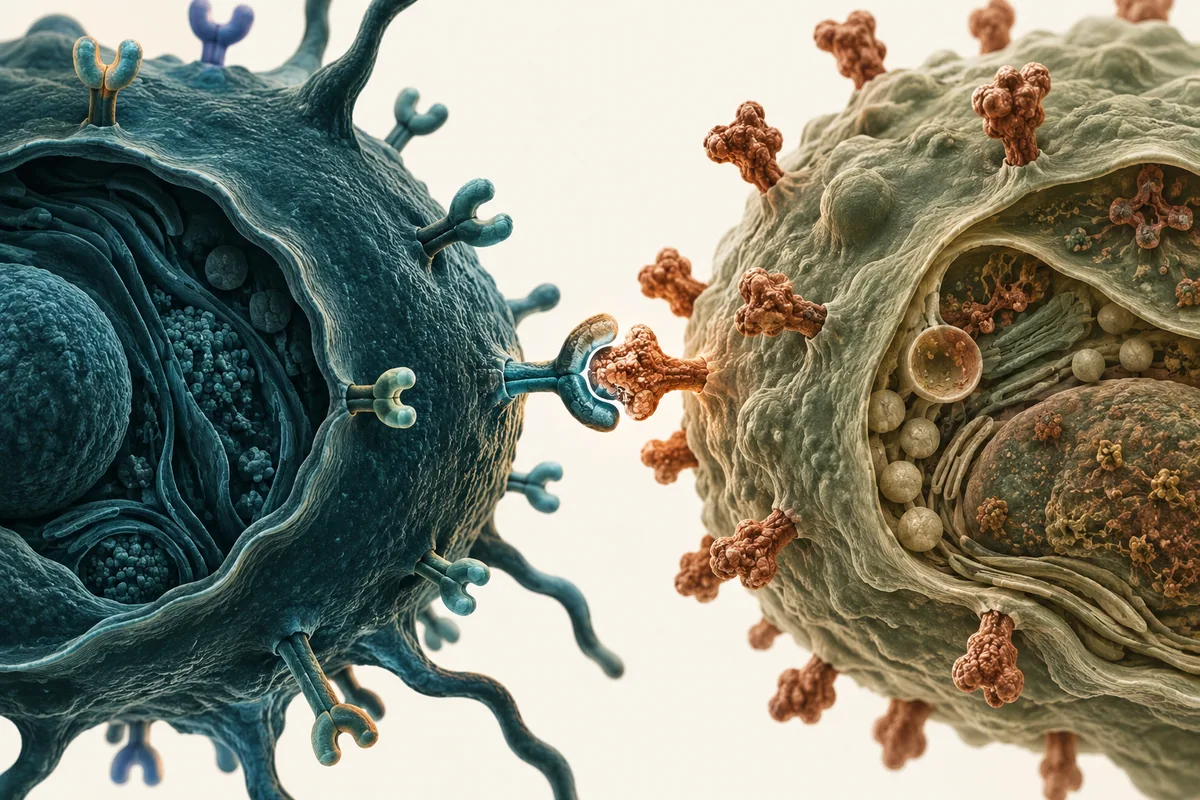
- Engineer the T cellThe recognition rule targets uPAR.
- Test the cells it recognisesTarget expression can vary with tissue and cell state.
- Measure function and follow-upMouse studies assess metabolism and intestinal outcomes.
The receptor recognises a surface feature. It does not independently diagnose senescence. Sources for this account.
The mechanism
The engineering problem begins with the target. Researchers need a surface protein that the T cell can reach, expressed strongly enough on the cells they want to remove. The foundation experiments identified uPAR through several senescence models and tested engineered T cells against it. A receptor recognises a molecular feature; it does not independently diagnose why a cell expresses that feature.
Senescence also has useful roles. In a separate mouse wound-healing study, removing senescent cells delayed wound closure; a secreted factor, PDGF-AA, helped explain the effect. This gives target selection a practical requirement: distinguish persistent harmful cells from transient cells helping tissue repair. A lower senescence-marker count alone cannot establish that the right cells were removed.
A living cell treatment adds another experimental dimension: how its activity changes after administration. The metabolic paper detected infused CAR T cells a year later. Follow-up therefore needs to track the engineered cells as well as the tissue being tested. A functional improvement at one time point and controlled targeting over a prolonged period are separate observations.
Human evidence
The intervention results summarised here come from mice and laboratory assays. They supply no verified human result showing restoration of metabolism or intestinal function in ageing. This dossier describes an academic research approach, with no named commercial treatment assigned to it.
For translation, the most revealing evidence would map which human cells express enough target protein to trigger killing, then test recognition in healthy and diseased tissue. Target abundance, tissue access and receptor behaviour all belong in that account. Mouse tolerability cannot settle those questions for a human cell product.
The study table also separates a glucose challenge from exercise testing and intestinal permeability. These measurements describe particular functions. Calling them a single measure of biological age would erase information about what changed and how it was tested.
Studies and experimental evidence
2020 uPAR-targeting foundation experiments
- Design
- Cell assays and controlled mouse experiments
- Population or model
- Cultured senescent cells; lung cancer and induced liver-fibrosis models
- Sample size
- Varies by assay and cohort; no single study-wide sample
- Comparison
- Unmodified T cells and control CAR T cells
- Duration
- Varies by model
- Outcome
- Cell killing, fibrosis and survival in a cancer model
Targeting reduced pathology in the tested models; the survival result concerned cancer-bearing mice.
Disease-model survival cannot establish lifespan extension during natural ageing.
Funding and interests: Academic study; grant and commercial-interest disclosures in the paper
2024 natural-ageing metabolic experiments
- Design
- Therapeutic and preventive mouse cohorts
- Population or model
- Naturally aged mice and mice treated when young
- Sample size
- Glucose challenge: 11, 12 and 12 mice across the three groups; other assays differ
- Comparison
- Unmodified T cells or a CAR that does not recognise mouse CD19
- Duration
- Glucose test at 2.5 months; preventive tests 15–18 months after infusion
- Outcome
- Glucose handling and exercise
The paper reports improved functional measurements and preventive metabolic effects.
Distinct cohorts, assays and follow-up periods; no human intervention results.
Funding and interests: Academic grants; authors disclose senolytic CAR T patent interests
2025 intestinal regeneration experiments
- Design
- Controlled therapeutic and preventive mouse experiments
- Population or model
- Young and aged mice; intestinal tissue and organoid assays
- Sample size
- Permeability assay: 10, 10, 13 and 14 mice across age and treatment groups; other assays differ
- Comparison
- Unmodified T cells; young animals provide an age reference
- Duration
- Six weeks for the listed permeability assay; other experiments differ
- Outcome
- Barrier function and regeneration
The study reports improved intestinal function in aged mice.
Mouse intestine and specific challenge models; no human efficacy measurement.
Funding and interests: Academic grants and fellowships; related patent interests disclosed
Development history
uPAR-targeting foundation published
Cell and mouse experiments establish the senolytic CAR T approach.
Metabolic study published
Research extends the approach into natural-ageing and preventive mouse experiments.
Intestinal study published online
A further mouse study examines tissue regeneration; the journal issue is January 2026.
Unresolved questions
- Which human cells would the receptor recognise during normal repair, infection or inflammation?
- How does target expression differ among tissues and among senescent cell states?
- Can researchers control or terminate activity if engineered cells persist?
- Do independent experiments reproduce the functional improvements with comparable controls?
- What changes remain after the targeted cells return, and which require further intervention?
A useful subsequent report would connect target specificity with functional outcomes and longer safety observation in a defined model. Any human programme would need its own named product, protocol and results record before being added here.
Sources
- Paper · 17 Jun 2020Senolytic CAR T cells reverse senescence-associated pathologies
Nature. Primary experiments; publisher records a February 2024 author correction.
Checked 4 Oct 2026 - Paper · 24 Jan 2024Prophylactic and long-lasting efficacy of senolytic CAR T cells against age-related metabolic dysfunction
Nature Aging. Figure 5 provides the glucose-assay counts; Figure 6 describes preventive follow-up.
Checked 4 Oct 2026 - Paper · 25 Nov 2025Anti-uPAR CAR T cells reverse and prevent aging-associated defects in intestinal regeneration and fitness
Nature Aging. Figure 2 specifies permeability sample sizes and timing.
Checked 4 Oct 2026 - Paper · 11 Dec 2014An essential role for senescent cells in optimal wound healing through secretion of PDGF-AA
Developmental Cell. Separate mechanistic background on beneficial senescence during mouse repair.
Checked 4 Oct 2026
Dr T Smith, organic chemist and science educator. Review date: 4 Oct 2026. Report a correction.