
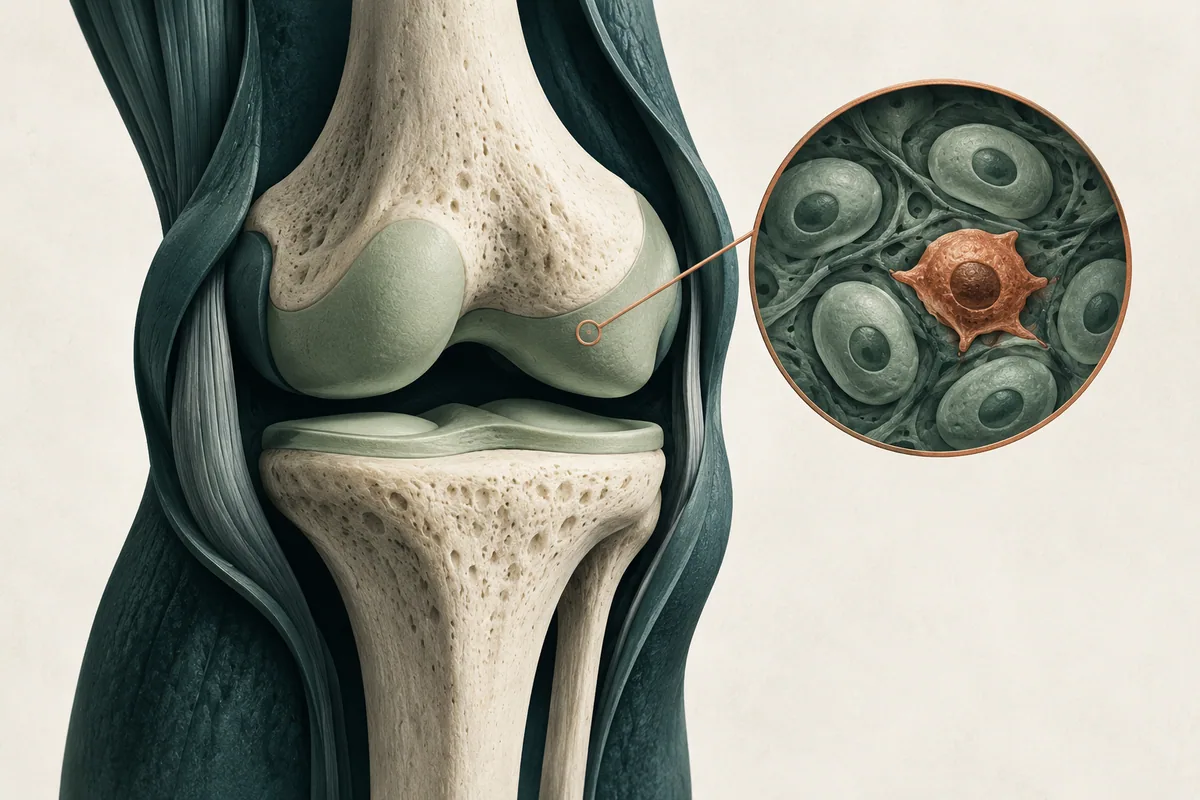
In August 2020, UNITY reported that none of the three UBX0101 groups differed significantly from placebo on the trial's twelve-week knee-pain endpoint. The company subsequently ceased development of the candidate.
The failed result belongs in a rejuvenation database. It tests a specific application of senolytic biology in people and shows how an attractive mechanism and early clinical observations can fall short in a larger controlled experiment.
UNITY's earlier claims remain alongside the controlled result, showing how the evidence changed during development.
The biological proposal
Senescent cells stop dividing and can release molecules that affect neighbouring cells and tissue. Persistent populations are implicated in several ageing-associated conditions. Researchers investigate whether selectively removing particular populations can improve function.
UBX0101 inhibits the interaction between p53 and MDM2. The programme proposed using this intervention to eliminate senescent cells in an osteoarthritic joint. The clinical question required the removal to produce a useful change in pain or function.
In 2017, Jeon and colleagues reported that local clearance of senescent cells reduced features of post-traumatic osteoarthritis in experimental models and promoted a regenerative environment. The work included mouse and laboratory evidence. Several authors disclosed company-related equity or intellectual-property interests.
An induced injury model gives researchers control over when damage begins and when they intervene. Long-standing human osteoarthritis includes a varied history of injury, inflammation and structural change. That difference is a reason to test translation; it does not identify the cause of a later failure.
What was promised before the result
UNITY's October 2019 announcement of first Phase 2 dosing referred to encouraging Phase 1 observations in pain, function and biological markers. Those were the company's interpretation of its early clinical work.
The announcement also specified the new trial's primary measure: knee pain at twelve weeks using WOMAC-A. Its randomised, blinded, placebo-controlled design was intended to examine whether the candidate improved outcomes beyond the comparison group.
A prespecified primary outcome prevents an assessment from drifting toward whichever later measurement looks best. It makes the negative result easier to interpret because the public record shows what the programme set out to establish.
The programme's purpose was an osteoarthritis benefit. A favourable result would have supported that indication and protocol. Whole-body senescence removal or longer human lifespan would still have required separate tests.
The controlled result
The August 2020 disclosure reported 183 participants assigned to placebo or one of three active groups receiving a single local injection. None of the active groups met the WOMAC-A primary endpoint against placebo at twelve weeks.
The placebo group's estimated pain change was about minus one point on the zero-to-four scale. Two active groups had changes close to the same value. Looking only at improvement from baseline could therefore have made the programme appear successful while concealing the lack of separation from placebo.
The company reported tolerability findings and said it did not expect to progress UBX0101 into pivotal studies. Its later SEC filing confirmed that development had ceased. The negative efficacy result and the reported safety observations answer different questions.
UNITY discontinued UBX0101 after the failed primary endpoint. The original trial remains identifiable as NCT04129944.
Where the explanation stops
The cited results disclosure does not establish that senescent cells were cleared to the necessary extent in the relevant human tissue. It therefore leaves several possible explanations open: inadequate exposure, insufficient biological effect, the chosen schedule, an unsuitable disease stage or a biological hypothesis that did not produce the expected clinical benefit.
These are hypotheses. Assigning one as the explanation would require additional evidence about exposure, target engagement and tissue effects.
An explanation offered after failure becomes stronger when it predicts a new experiment's result and that experiment is completed.
The underlying cell state is also context dependent. Demaria and colleagues' mouse wound-healing experiments showed a beneficial role for transient senescent cells in repair. Broadly labelling every senescent cell as unwanted loses that biology. A candidate needs a rationale for the cells it targets, at the time it targets them.
Later senolytic candidates have different targets, tissues and protocols. UBX0101's failure cannot determine all of their outcomes. It does lower confidence in treating a shared mechanism name as a sufficient prediction of benefit.
UNITY subsequently focused on an ophthalmology programme involving a different candidate. The history should identify it as a separate intervention with its own evidence. Changing the indication or molecule creates another test.
The unresolved question is specific: what additional measurements would distinguish failure to reach the intended biological effect from failure of that effect to improve the clinical outcome? Future programmes can make those measurements part of their design.
Sources
- Company disclosure · 17 Aug 2020UNITY Biotechnology Announces 12-week data from UBX0101 Phase 2 Clinical Study in Patients with Painful Osteoarthritis of the Knee
Primary company disclosure including group results and the failed prespecified endpoint.
Checked 4 Oct 2026 - Company disclosure · 2021-11UNITY Biotechnology Form 10-Q for the quarter ended 30 September 2021
Issuer filing confirms UBX0101 development ceased after Phase 2 and distinguishes the subsequent ophthalmology programme.
Checked 4 Oct 2026 - Paper · 24 Apr 2017Local clearance of senescent cells attenuates the development of post-traumatic osteoarthritis and creates a pro-regenerative environment
Primary mouse and laboratory work; includes company-related interests.
Checked 4 Oct 2026 - Company disclosure · 31 Oct 2019UNITY Biotechnology Announces First Patient Dosed in Phase 2 Study of UBX0101 in Osteoarthritis of the Knee
Before-results disclosure specifying the trial's primary outcome and planned design.
Checked 4 Oct 2026 - Paper · 11 Dec 2014An essential role for senescent cells in optimal wound healing through secretion of PDGF-AA
Primary mouse wound-healing experiments.
Checked 4 Oct 2026 - Trial registry · Live recordNCT04129944: UBX0101 in osteoarthritis of the knee
Identifier cited in the phase 2 results disclosure.
Checked 4 Oct 2026
Dr T Smith, organic chemist and science educator. Report a correction.