
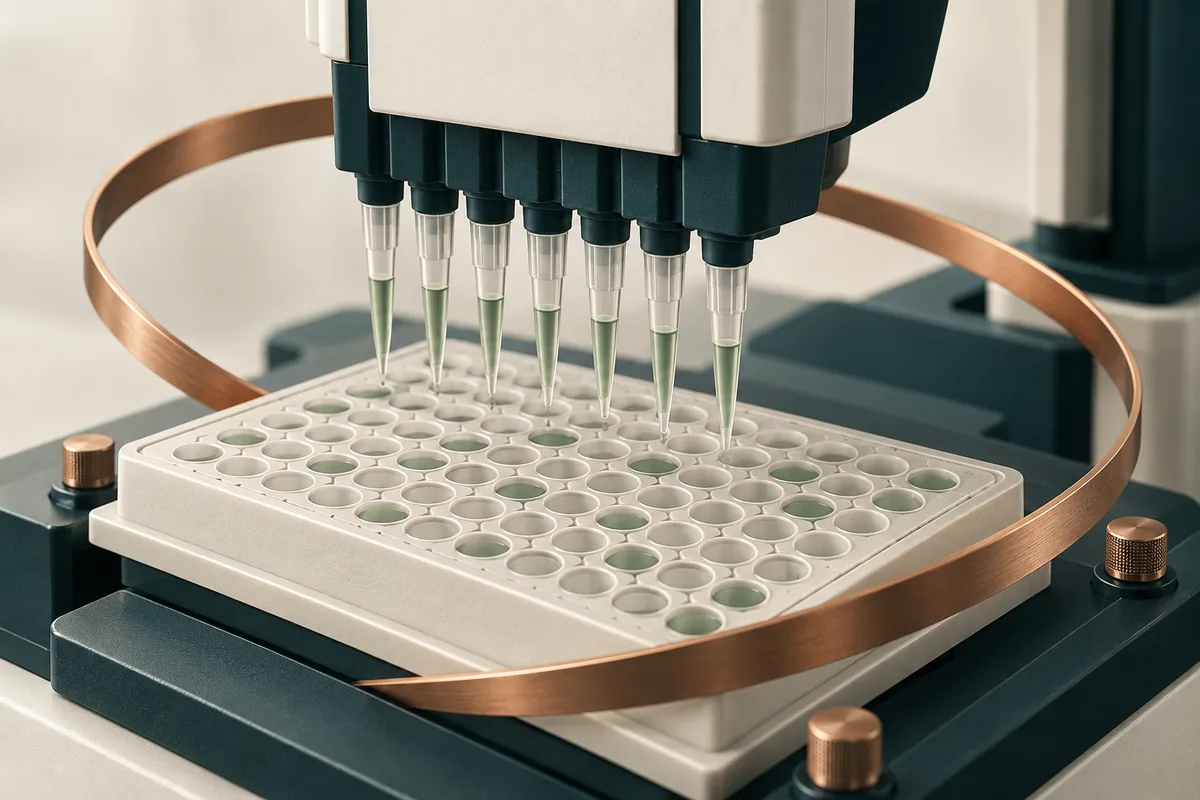
A laboratory robot can execute a fixed list of experiments. A system that learns from experiments also needs a rule for choosing the next list. Researchers give it a measurable objective, the allowed operations and a way to interpret the assay. The system proposes a batch, obtains physical results and uses those results to choose another batch.
That cycle is called a closed loop. Its usefulness depends on what the assay rewards. If a model is asked to maximise a fluorescent signal, the experiment must establish what that signal represents. If it is asked to reduce a production cost, the calculation must define which costs are included and how much usable product was made.
The February 2026 OpenAI and Ginkgo Bioworks account and the August 2026 REAP paper describe two different tasks. One searched reaction compositions for protein synthesis. The other searched enzyme sequences for better performance in selected reactions.
- Choose the next batchThe model uses prior measurements and a stated objective.
- Run physical assaysKeep preparation, controls and failures in the record.
- Use the new measurementsUpdate predictions before choosing another batch.
The final step feeds the next cycle. People define and maintain the physical workflow. Sources for this account.
Changing the reaction mixture
Cell-free protein synthesis uses cellular machinery in a reaction mixture to make a protein from a DNA template. Researchers can vary the mixture without growing a new cell culture for every composition. The OpenAI and Ginkgo team reports six rounds spanning six months, more than 36,000 unique compositions and 580 automated plates. Its associated research remains a preprint in the records checked for this edition.
The preprint reports a lowest calculated reaction cost of $422 per gram of superfolder green fluorescent protein, against $698 per gram for its literature benchmark. The authors used common unit costs to calculate the comparison. This is the basis of the reported 40% reduction.
Cost per gram divides the reaction cost by the amount produced. Increasing output can lower that ratio even if the mixture itself costs the same. The calculation is therefore sensitive to protein yield as well as reagent prices. It does not establish a 40% reduction in the total cost of producing a purified, formulated medicine with its required quality controls.
A reaction's oxygen supply, mixing and surface area change with its vessel. A result in a small assay should retain the tested geometry and volume when researchers discuss transfer to production. The paper's cost comparison is a laboratory benchmark, and the best composition for one protein need not be the best for another.
People changed the system too
Ginkgo personnel tested reagent stocks for precipitation and dispensing problems. The team also changed the DNA template and lysate preparation during the study, and gave GPT-5 further tool access. These changes accompanied improved results. They prevent assigning the entire gain to the model's choice of mixture alone.
To estimate the model's contribution, a comparison would hold the physical workflow and resources constant while changing how experiments are chosen. An expert team, random search or another optimisation method could each supply a comparator. Their experiment budgets and access to prior information would need to be stated.
People still prepare materials and troubleshoot the system. A robot receives materials whose composition and behaviour people have already established. Software receives an assay and operating constraints. Autonomy can apply to a defined part of that workflow while people continue to improve the surrounding system.
Changing the enzyme sequence
REAP combines a protein language model with a predictor trained on measured activity, selects variants and feeds robotic test results back into the predictor. The paper appeared on 3 August 2026. Its P450 work started from FL#62, an enzyme already carrying 16 substitutions, and sought improved formation of a specified hydroxylated product.
The authors report five engineering cycles over five weeks. The best fifth-round screening variant produced about 45 times the starting variant's yield; subsequent trajectory analysis led to a constructed quintuple variant with a reported 57-fold improvement. That denominator is FL#62. A separate Sortase A application reported gains up to 104-fold against its wild-type baseline.
Both ranking and predicted activity can help choose experiments. Ranking asks which candidate should be tested first. A quantitative prediction estimates the size of the measured outcome. They can fail differently: a model might order candidates correctly while overestimating every result. The batch-selection rule also determines how much effort goes into uncertain candidates whose tests could improve the model.
Scroll the table sideways to read all columns.
| Study | Object changed | Measured outcome | Evidence status |
|---|---|---|---|
| OpenAI/Ginkgo CFPS | Reaction composition | Protein titer and calculated reaction cost per gram | Collaborator preprint |
| REAP | Enzyme sequence | Activity in specified reactions | Peer-reviewed paper |
| SAMPLE | Enzyme sequence | Thermal tolerance | Peer-reviewed paper |
Keep an independent physical check
The 2024 SAMPLE study gives an earlier example. Four agents searched for glycoside hydrolases with greater thermal tolerance. Researchers then checked their selected enzymes using human laboratory protocols. The improvements persisted, but measured thermostability differences were smaller than in the automated setup because expression and assay conditions differed.
An independent check can expose dependence on the original setup. Retest selected candidates using separately prepared samples, preserve the unsuccessful experiments and report variation between batches. A comparison of search methods should include every experiment consumed by the search, including initial training and quality-control work.
For ageing research, a faster cycle could help investigate targets or produce experimental proteins. The biological objective still needs justification. Improving synthesis yield or an enzyme assay supplies no evidence that the resulting process restores function in an aged tissue. That requires the corresponding tissue experiment, with the intervention, control and observation period stated.
Sources
- Developer report · 5 Feb 2026GPT-5 lowers the cost of cell-free protein synthesis
OpenAI's collaborator account with Ginkgo. Scale and six-round description are author-reported, not an independent replication.
Checked 4 Oct 2026 - Preprint · 5 Feb 2026Using a GPT-5-driven autonomous lab to optimize the cost and titer of cell-free protein synthesis
Associated bioRxiv DOI 10.64898/2026.02.05.703998. Full primary PDF checked for cost basis, human changes, reaction geometry and chronology. Reaction costs exclude the full manufacturing and quality-control costs of a medicine.
Checked 4 Oct 2026 - Paper · 3 Aug 2026Rank-guided learning accelerates automated enzyme engineering
Primary paper and publisher PDF checked. Version of record dated 8 September 2026. Main text distinguishes fifth-round screening yield from the subsequently constructed 57-fold quintuple variant. P450 baseline FL#62 is already engineered; Sortase A uses a different baseline.
Checked 4 Oct 2026 - Paper · 11 Jan 2024Self-driving laboratories to autonomously navigate the protein fitness landscape
Primary autonomous glycoside-hydrolase engineering study, including subsequent human characterisation under different expression and assay conditions.
Checked 4 Oct 2026
Dr T Smith, organic chemist and science educator. Report a correction.