
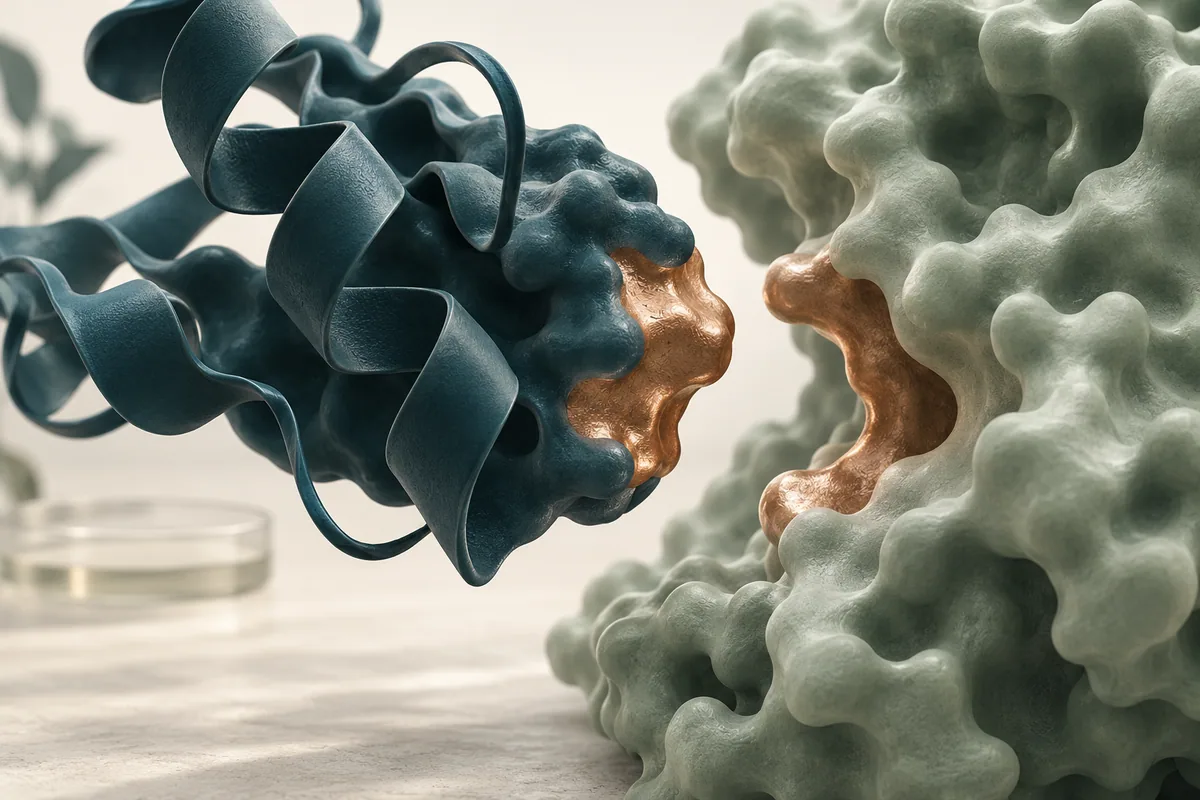
Researchers can now ask a model for a protein with a specified molecular job, make selected designs and measure whether they do that job. The most informative reports follow the designs through those steps. A picture of a predicted complex supplies a proposed explanation for an interaction; the physical measurement determines whether the interaction occurs under the tested conditions.
AlphaFold's 2021 paper established substantial progress in predicting structure from sequence. Protein design starts with a requirement and searches for a sequence and structure that meet it. The 2023 RFdiffusion study demonstrated this approach through experimentally characterised assemblies and binders. A designed binder's structure in complex with influenza haemagglutinin closely matched its computational model.
That agreement answers a structural question. If the intended job is to change a cell's behaviour, the experiment must continue into the cell.
Count the proteins that reached the assay
The BindCraft paper, published online on 27 August 2025, reports binders against several targets. These selected examples retain the number physically tested and the binding assay. They describe different experiments; the fractions should not be pooled into a universal success rate.
A computational run produces candidates that are filtered and ranked before researchers make proteins. The table's denominator is the experimentally tested set. It does not count every generated candidate, and it does not say how many of the binding hits would pass a later functional or development test.
Scroll the table sideways to read all columns.
| Target | Proteins tested | Binding hits | Measurement |
|---|---|---|---|
| PD-1 | 53 | 13 | Biolayer interferometry; bivalent Fc fusions |
| PD-L1 | 9 | 7 | Surface plasmon resonance |
| IFNAR2 | 9 | 3 | Surface plasmon resonance |
| CD45 | 16 | 4 | Surface plasmon resonance |
What a binding measurement establishes
Affinity describes how strongly a binder and target associate under specified conditions. For a simple reversible interaction, the dissociation constant, Kd, relates the concentrations of free partners to the concentration of their complex. Lower Kd means tighter binding in that model. It says nothing by itself about what the occupied target does.
The format can change the measurement. BindCraft's strongest PD-1 result used a bivalent Fc fusion, with apparent Kd below 1 nM. The authors could not determine the exact Kd because dissociation was very slow and avidity affected the measurement. Multiple simultaneous contacts can hold a construct to its target more strongly than one isolated contact.
A protein that binds a receptor might block its natural ligand, activate the receptor or attach without producing either effect. Researchers need a functional assay for the intended action. They also need specificity measurements: strong attachment to the chosen target leaves open attachment to other proteins.
Expression and stability answer further questions. Can the protein be produced in a soluble form? Does it retain its structure during the intended use? A binder that works at one concentration in a purified preparation still needs testing in the environment where researchers want to use it. Those tests also determine whether the apparent activity comes from the designed interaction or from an unwanted property of the preparation.
Delivery and catalysis extend the test
BindCraft also supplied receptor binders for modified AAV capsids. Experiments assessed reporter delivery to cells expressing HER2 or PD-L1. This is a cellular delivery result; it does not establish selective distribution across a person's tissues or the safety of a therapeutic payload.
RFdiffusion3 works with explicit atomic geometry around proteins and other molecules. Its cited version is a preprint, revised on 19 November 2025. The accessible current record still labels it as unreviewed by a journal. Its physical tests included one DNA-binding hit among five tested designs, with an assay EC50 of about 5.9 micromolar, and 35 designs with repeated catalytic turnover among 190 screened hydrolase designs.
The hydrolase experiment tested cleavage of a specified activated ester substrate. Repeated turnover shows the enzyme can process further substrate after a reaction. It does not establish activity against an arbitrary physiological substrate. The DNA assay's EC50 describes the concentration giving half of the fitted response in that experiment; it should retain that label when compared with an independently determined Kd.
Which claim survives the experiment?
Protein design has several stages: a sequence proposed by a model, a protein produced successfully, a measured interaction and the intended effect. A report can have strong evidence at one stage and little evidence at another.
For delivery research, the next useful comparison measures entry into intended and unintended cells, the amount of payload delivered and its effect. For an enzyme, it measures reaction rate, substrate range and behaviour under the required conditions. For a therapeutic binder, it also follows exposure, immune responses and the consequences of sustained target engagement.
These tools can supply molecules for experiments on ageing biology. A proposed longevity application still needs its own target rationale and functional evidence. The protein-design studies described here did not measure human rejuvenation or lifespan extension.
Sources
- Paper · 15 Jul 2021Highly accurate protein structure prediction with AlphaFold
Primary structure-prediction study; prediction and functional protein design answer different questions.
Checked 4 Oct 2026 - Paper · 11 Jul 2023De novo design of protein structure and function with RFdiffusion
Primary generative-design study with experimental structural and binding validation.
Checked 4 Oct 2026 - Paper · 27 Aug 2025One-shot design of functional protein binders with BindCraft
Online publication date; issue dated 9 October 2025. Main-text denominators retained separately by target. Bivalent PD-1 apparent affinity and cellular AAV delivery do not establish clinical efficacy.
Checked 4 Oct 2026 - Preprint · 19 Nov 2025De novo Design of All-atom Biomolecular Interactions with RFdiffusion3, version 2
Version 2 of the bioRxiv preprint first posted 18 September 2025. Current accessible PMC record explicitly labels it a preprint. Experimental DNA-binding and hydrolase counts come from its experimental section.
Checked 4 Oct 2026
Dr T Smith, organic chemist and science educator. Report a correction.